For most of the history of corporate video, the first question about any scene was practical: can we afford to film it? A second location, an aerial shot, a crew in another city. The budget decided what reached the screen.
That question is changing. Today almost any image can be generated: a factory that does not exist, a crowd that never gathered, a smiling customer who was never a customer. The question for every brand is no longer whether a scene can be made. It is whether it should be filmed for real. The answer now shapes brand authenticity as much as the message itself.
We have worked on both sides of that question. In 2023, our anniversary film for TOPMIND, “20 Years in the Blink of an Eye,” combined real imagery with AI-generated images, the first time we used the technique in our own work. And for nearly two decades we have filmed people, places and products that exist. This is our answer to where the line sits, and why it matters more every year.
The New Default Is Synthetic
In 2025, Merriam-Webster chose “slop” as its Word of the Year, defined as digital content of low quality produced usually in quantity by means of artificial intelligence. Search behavior tells the same story. According to Ahrefs estimates, monthly US searches for “AI slop” grew from about 4,400 in October 2024 to about 56,000 in October 2026.
The people who run the platforms see it too. As reported by The Decoder, Instagram head Adam Mosseri argued at the turn of 2026 that authenticity is becoming infinitely reproducible, and suggested that camera makers could cryptographically sign images at capture, so that real footage can be verified. The industry is already building that kind of verification through the C2PA’s Content Credentials standard, which records where a piece of media came from and how it was changed.
Audiences have noticed. In Animoto’s State of Video 2026 survey of US consumers, 82.6% said they had watched a video they suspected was AI-generated.
Audiences Are Drawing a Line
Suspicion would be a curiosity if it did not affect trust. It does. Three recent surveys point the same way: consumers want authenticity, and they link it to real people.
- In the same Animoto survey, 36% of consumers said AI-generated videos lower their trust in a brand, 77.9% said they trust videos with real people, and 68% named real people as the number one factor in creating a sense of authenticity.
- Canva’s 2026 State of Marketing and AI report, conducted with The Harris Poll in seven countries, found that 78% of consumers would rather see ads made by people, even if AI could make them better, and 87% say the best advertising still needs a human touch. In the same study, 97% of marketing leaders said they use AI in their everyday creative work.
- In Clutch’s June 2026 survey of 408 consumers, 33% said AI worsens their perception of a brand, while 16% said it improves it.
The Brand Authenticity Gap
Read together, the numbers describe a brand authenticity gap. Marketing teams are adopting AI almost universally. Audiences are not rejecting it, but they are sorting what they see into two piles: what they believe happened and what they assume was made. Every brand needs to know which pile each of its films will land in. Films meant to earn customer trust belong firmly in the first.
When a Brand Gets the Line Wrong
In December 2025, McDonald’s Netherlands removed an AI-generated Christmas ad after a wave of criticism online. The film was made by production company The Sweetshop Films and agency TBWA/Neboko. Defending the work on LinkedIn, The Sweetshop’s CEO described the effort behind it as “Ten people, five weeks, full-time.” McDonald’s called the episode an important learning as it explores the effective use of AI.
Two lessons stand out for us. Generated does not mean cheap or fast: ten people spent five weeks on that film. And effort does not buy belief. In our reading, the problem was not the craft. Viewers found nothing real to hold on to. That is the risk with AI-generated ads that imitate real life: the more convincing they look, the more viewers ask what actually happened.
What Generation Does Well
None of this makes generated imagery the enemy. AI in video production, used for the right job, is a powerful tool, and we use it.
Explaining What Cannot Be Seen
Software, data, financial products, regulation and ideas have no physical form to film. Animation and generated imagery give them one. For the UN Global Compact Network Brazil’s agroindustry anti-corruption initiative, we produced an eight-part animated series in Portuguese, Spanish and English, because the subject was behavior and integrity, not a place a camera could visit. See how video helps explain complex solutions.
Showing What Cannot Be Filmed Again
The past, the future and the imagined are natural territory for generation. TOPMIND’s anniversary film had to compress twenty years of change into two minutes. We combined real imagery with AI-generated images to tell a story about time and transformation, while keeping its focus on the relationships the company built, with participation from customers such as Nestlé, Nivea and Mosaic.
Speeding Up the Work Around the Film
AI tools already shorten transcription, subtitles, first-pass translations and edit preparation. That time goes back into what audiences notice: the story, the performance, the light. We covered this in our article on whether AI can replace a video production company.
What Is Worth Filming for Real
Our test is simple. If a viewer later learned that a shot was generated, would they feel misled? If the answer is yes, film it. In practice, that covers five kinds of content.
People Who Stand Behind Their Words
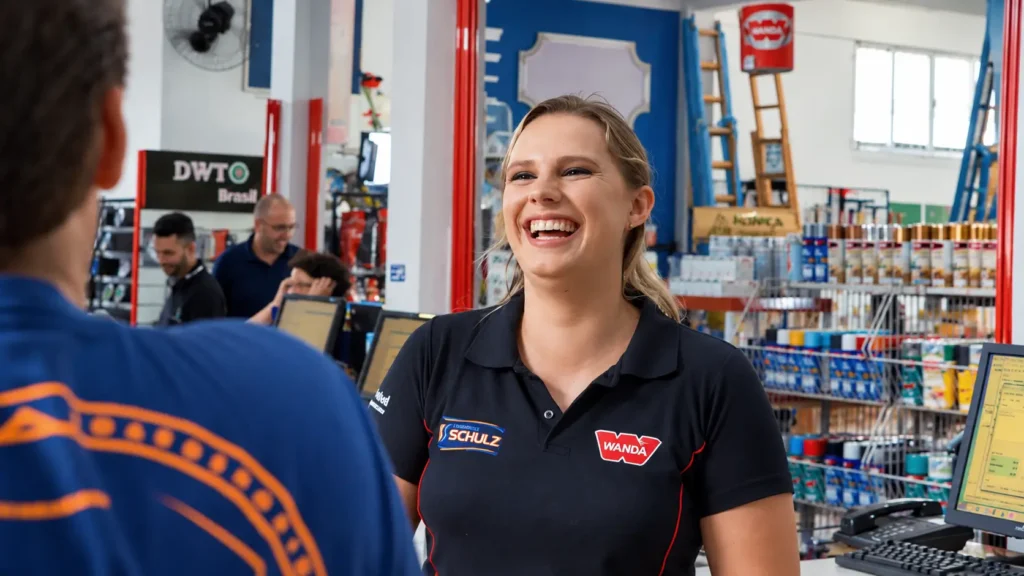
A testimonial works because a real person puts their face and name behind a claim. A generated customer can say anything, which is exactly why it proves nothing. For AkzoNobel’s international Colorvation campaign, our crew traveled from São Paulo to Rio de Janeiro and Pelotas to film two Brazilian customers at their own businesses, explaining in their own words what the technology changed in their working day. Their voices were the evidence. More on client testimonial videos.
Places That Prove Capability
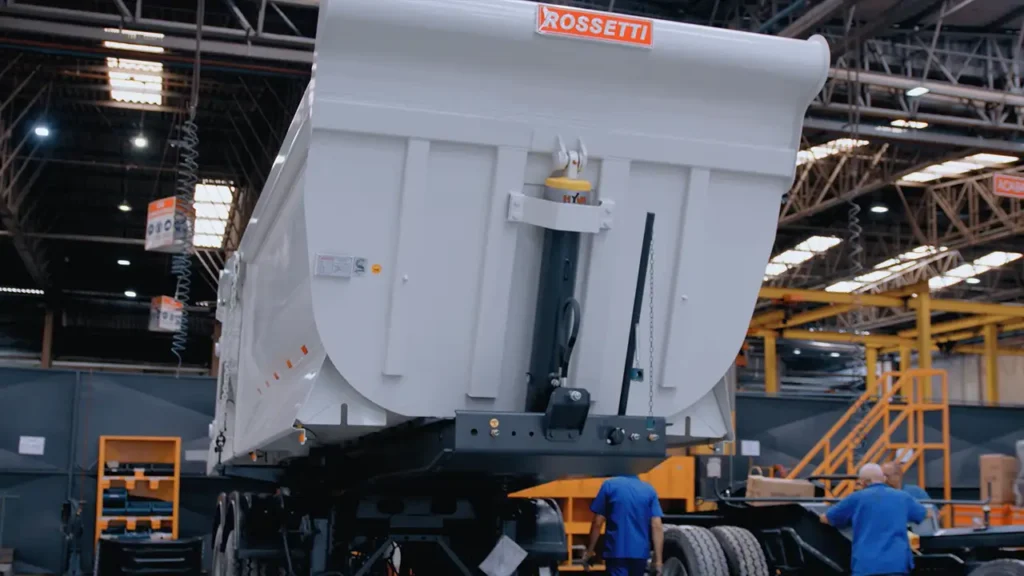
A buyer evaluating a manufacturer wants to see the factory, not an idea of one. For Rossetti, we filmed at its facility in Guarulhos in a single day: aerial views for scale, ground-level cinematography for detail and a tipper body unloading to show the equipment doing the job it was built for. A generated factory could look more polished. It could not prove anything. More on corporate films.
Leaders and Teams
When a CEO speaks to employees, investors or customers, the message carries weight because it is really them. The same goes for the people who represent a company in a global series. For KPMG’s People Stories, produced by London’s Beagle Media, we filmed the Brazilian chapter in Belo Horizonte in one day, with the interview directed live from London. See our work in internal communications.
Products and Demonstrations
When a film shows what a product does, it makes a promise. A demonstration filmed for real is evidence. A generated one is an illustration, and audiences and regulators increasingly expect to be told the difference. More on product launch films.
Moments That Happen Once
An anniversary, a launch, a plant opening, a team that will never be in the same room again. These moments are valuable precisely because they happened. Film them while they are happening. A brand documentary keeps them on record long after the day itself.
The Law Is Drawing the Same Line
From 2 August 2026, Article 50 of the EU AI Act requires those who use AI to generate or manipulate image, audio or video content constituting a deep fake to disclose that the content has been artificially generated or manipulated. The regulation defines a deep fake as content that resembles existing persons, objects, places, entities or events and would falsely appear to a person to be authentic or truthful. For evidently artistic, creative, satirical or fictional work, the duty is lighter: the disclosure must not hamper the display or enjoyment of the work.
That definition is, in effect, the test above written into law. If a generated scene would make a viewer believe something happened that did not, the brand has to say so. For any film that will run in Europe, that decision belongs in the brief, not in the edit, and the details deserve a conversation with your legal team. It is one more reason to plan multi-market production market by market before the shoot.
A Brief for the Synthetic Era
Before your next production, ideally in pre-production, answer these questions with your team and your production partner:
- What must be true for this film to work? Film that.
- What only needs to be understood? Animation or generated imagery may serve it better.
- Who has to appear on camera, and how much of their time will we need?
- Which shots, if any, will be generated, and how will that be disclosed in each market?
- Will this footage need to prove something later, to a customer, an investor or a regulator?
What Becomes Scarce
When anything can be created, what actually happened becomes the scarce material. A real customer, a real factory floor, a real leader speaking in their own words: no tool can produce these on demand, and they are what audiences say they trust. That is where brand authenticity now lives.
That has been our work for nearly two decades and more than 400 clients, and we expect it to matter more in the decade ahead. We will keep using AI where it helps a story be understood. We will keep filming for real whatever needs to be believed.
If you are deciding where that line sits in your next project, talk to Laura Prado, our Commercial Director.